Cigarette Beetle Facts & Information
Everything you need to know about cigarette beetles
What Do Cigarette Beetles Look Like
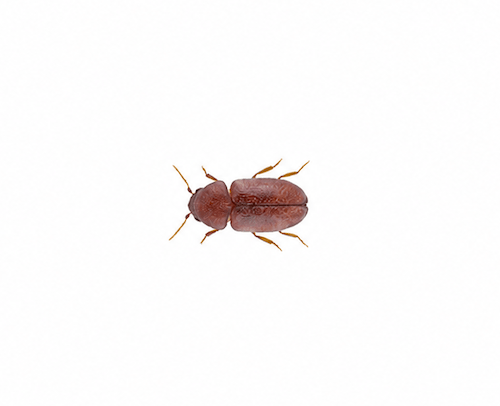
Adult cigarette beetles, Lasioderma serricorne (Coleoptera: Anobiidae), are quite small, measuring about 1/8 of an inch and are reddish brown. Their bodies have an oval-shaped and the head is often concealed by the pronotum – a rounded plate covering the head when the beetle is viewed from above. The elytra (hard wing coverings that make up the beetle’s “shell”) are covered with fine hairs. When disturbed, they often pull in their legs, tuck their head, and lay motionless. They prefer to reside in dark or dimly lit cracks, nooks, and crevices but become active and fly readily in bright, open areas in an attempt to find refuge. They are most active at dusk and will continue activity through the night. Adults do not feed but will drink liquids.
Cigarette beetles look almost identical to drugstore beetles but can be distinguished by two easily identifiable characters: the antennae of the cigarette beetle are serrated (like a series of teeth on a saw). It gets its species name, “serricorne,” from this feature. Serricorne is latin for “serrated antennae.” In comparison, the antennae of the drugstore beetle end in 3-segmented clubs. The other difference is that drugstore beetle elytra have rows of pits giving them a striated (lined) appearance while those of the cigarette beetle are smooth with fine hairs.Not the beetle you have?
Cigarette beetles look almost identical to drugstore beetles but can be distinguished by two easily identifiable characters: the antennae of the cigarette beetle are serrated (like a series of teeth on a saw). It gets its species name, “serricorne,” from this feature. Serricorne is latin for “serrated antennae.” In comparison, the antennae of the drugstore beetle end in 3-segmented clubs. The other difference is that drugstore beetle elytra have rows of pits giving them a striated (lined) appearance while those of the cigarette beetle are smooth with fine hairs.Not the beetle you have?
Where Do Cigarette Beetles Live
Cigarette beetles are commonly found in warm, dark, and undisturbed areas where they have access to food sources. Regardless of their name, they infest more than just tobacco including spices, dried herbs, pet food, grains, flour, cereal, and other packaged foods. In commercial facilities, cigarette beetles may live in food storage areas, processing equipment, warehouses, and behind or beneath shelving where food debris can accumulate. They can also hide inside product packaging–making infestations difficult to detect until beetles or damaged products become visible.
How Did I Get Cigarette Beetles
In addition to the dubious honor of being the most damaging pest of stored tobacco, the cigarette beetle is a major pest of many stored food products including flours, dry mixes, dried fruits such as dates and raisins, cereals, cocoa, coffee beans, herbs, spices, nuts, rice, dry dog food and other products kept in kitchen cabinets, pantries, hurricane food supply storage containers, and other areas in homes and businesses. Non-food products that it infests include dried plants and herbarium specimens, dried floral arrangements, potpourri, decorative grapevine wreaths, prescription drugs and pills, medicinal herbs, pinned insects, furniture stuffing, papier-mâché, and bookbinding paste. Cigarette beetles harbor symbiotic yeasts that produce B vitamins. The yeasts are deposited on the eggs as they are laid and consumed by the larvae during egg hatch. These yeasts enable the cigarette beetle to feed and survive on many foods and other items of poor nutritional quality. If you have any of those things in your home or business, then you could be attracting cigarette beetles.
What Problems Do Cigarette Beetles Cause
Larval feeding causes direct damage to foodstuffs and non-food items. They burrow into products and feed internally until emergence as adults. The products are contaminated by the presence of beetles, larvae, pupae, cocoons, frass (fecal material), and insect parts from dead insects. Beetles can chew directly through cardboard boxes, containers, and packaging to get to the products inside, causing significant damage. Cocoons are often attached to a solid substrate very close to the food source. Larvae will sometimes bore their way through cardboard boxes and other packaging in search of a place to pupate.
How Do I Prevent Cigarette Beetles
The cigarette beetle is a frequent pest in flour mills, bakeries, pet food factories, breakfast cereal manufacturing centers, snack food plants, chocolate factories, confectionaries, wholesale distribution centers, and sometimes in retail stores like grocery markets. Integrated pest management (IPM) programs must be implemented by knowledgeable professionals to control infestations at processing, distribution, and storage facilities. These programs should include inspections of incoming products and ingredients, pheromone monitoring in processing and storage areas and judicious insecticide applications as needed. But only fumigation can take care of a severe infestation immediately. We have a partner at Western Fumigation that can provide fumigation services for cigarette beetles (and lots of other pests!).
Why Waltham for cigarette beetle control
We’re passionate about keeping beetles out of your home or business because we live and work here – it’s our neighborhood, too. With our 133+ years of experience keeping homes and businesses in Massachusetts, Connecticut, New York, Maine, Vermont, New Hampshire, and Rhode Island safe from pests, Waltham has the experience you can trust. Call Waltham first!
Satisfaction Guarantee
24-Hour Guaranteed Response
Board Certified Entomologists

Say Goodbye to Cigarette Beetles
GET MY QUOTE