Merchant Grain Beetle Facts & Information
Everything you need to know about merchant grain beetles
What Do Merchant Grain Beetles Look Like
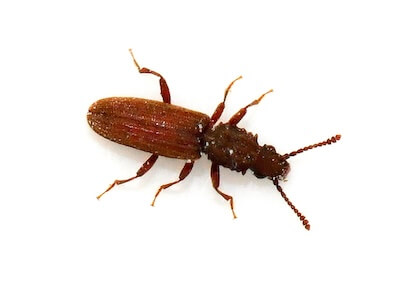
Adult merchant grain beetles, Oryzaephilus mercator (Coleoptera: Silvanidae), are small, flat, reddish-brown beetles that measure about 1/10 to 1/8 of an inch long. Their bodies are narrow and elongated, making them well adapted to crawling into cracks, crevices, and small openings in food packaging. Merchant grain beetles have distinctive saw-like projections along each side of the thorax. These projections are the origin of the name of the sawtoothed grain beetle – a close relative of the merchant grain beetle. Merchant grain beetles and sawtoothed grain beetles are almost identical in appearance. can be difficult to tell the difference without a trained eye. For example, their antennae and features on their heads are different. The experts at Waltham Pest Services know how to tell them apart.
Behaviorally, the merchant grain beetle is generally more tolerant of warm, humid conditions and is particularly common in warmer climates and facilities where moisture levels are elevated.Not the beetle you have?
Behaviorally, the merchant grain beetle is generally more tolerant of warm, humid conditions and is particularly common in warmer climates and facilities where moisture levels are elevated.Not the beetle you have?
Where Do Merchant Grain Beetles Live
Merchant grain beetles are commonly found in warm, humid areas where stored food products are available. They can live in food processing facilities, grain storage areas, warehouses, distribution centers, grocery stores, restaurants, commercial kitchens, and residential pantries. They often hide in cracks and crevices, behind or beneath shelving and equipment, inside packaging, and in areas where food debris accumulates. In commercial facilities, they may be found around processing equipment, product storage areas, receiving docks, and other locations where infested products are handled. Because merchant grain beetles can survive on a broad range of stored foods, infestations can spread from one product or storage area to another if sanitation and control measures are not maintained.
How Did I Get Merchant Grain Beetles
Merchant grain beetles are common stored-product pests that can infest a wide variety of dry foods. They are frequently introduced into homes and businesses through infested food products, packaging, or materials brought in from suppliers. They can infest cereals, grains, flour, pasta, dried fruits, nuts, seeds, chocolate, pet food, spices, and other processed or packaged foods.
In commercial facilities, merchant grain beetles may enter through incoming raw materials or finished products and spread throughout storage and processing areas. Because they are small and can enter through very small openings, infestations may go unnoticed until beetles are discovered in products, packaging, or around storage areas. They often proliferate in expired or damaged products and ingredients, indemnified and forgotten in an undisturbed place.
If your home or business stores or processes susceptible food products, an infestation can develop quickly when food debris, spilled product, or improperly stored materials provide an accessible food source.
In commercial facilities, merchant grain beetles may enter through incoming raw materials or finished products and spread throughout storage and processing areas. Because they are small and can enter through very small openings, infestations may go unnoticed until beetles are discovered in products, packaging, or around storage areas. They often proliferate in expired or damaged products and ingredients, indemnified and forgotten in an undisturbed place.
If your home or business stores or processes susceptible food products, an infestation can develop quickly when food debris, spilled product, or improperly stored materials provide an accessible food source.
What Problems Do Merchant Grain Beetles Cause
Merchant grain beetles are important stored-product pests because both the adults and the larvae infest and contaminate food products. They commonly feed on damaged grains and processed food products, and their presence can lead to product loss, contamination, and costly disposal. Infested products may contain adult beetles, larvae, pupae, insect parts, fecal material, and other debris. Because they’re small, and adept at hiding, they are invariably not seen, infested goods are moved not only other parts of your facility, but to your vendors’ too. And the infestation goes with them. Merchant grain beetles can spread through packaged goods within and among overpacks and pallets, making them particularly challenging for food manufacturers, warehouses, distributors, and retailers. In commercial environments, an infestation can result in rejected products, production interruptions, increased sanitation requirements, and potential damage to a company’s reputation. Finding the source of an infestation is critical because beetles can remain hidden in overlooked product residues and inaccessible areas.
How Do I Prevent Merchant Grain Beetles
Integrated pest management (IPM) programs are an important part of preventing and controlling merchant grain beetles. Routine inspections, sanitation, proper food storage, monitoring devices, pest-proofing, moisture management, and pheromone or other monitoring techniques where appropriate can all help. When a beetle infestation is established, identifying and eliminating the source is essential. Heavily infested products must be removed and most likely discarded, while thorough cleaning can help eliminate food residues that support continued activity. In severe commercial infestations, professional insecticide application may be necessary to eliminate beetles hidden throughout the facility and protect products from further contamination. Professional pest management and, when necessary, specialized fumigation services can provide an effective solution for merchant grain beetles and other stored-product pests.
Why Waltham for merchant grain beetle control
We’re passionate about keeping beetles out of your home or business because we live and work here – it’s our neighborhood, too. With our 133+ years of experience keeping homes and businesses in Massachusetts, Connecticut, New York, Maine, Vermont, New Hampshire, and Rhode Island safe from pests, Waltham has the experience you can trust. Call Waltham first!
Satisfaction Guarantee
24-Hour Guaranteed Response
Board Certified Entomologists

Say Goodbye to Merchant Grain Beetles
GET MY QUOTE